
South Indian Wedding Rituals - Complete Guide
South Indian Wedding Traditions Guide
South Indian weddings are rich in culture and meaningful rituals that celebrate the union of two families. While many traditions are shared across the region, each community has its own unique ceremonies, rituals, attire, and food.
This blog explores South Indian weddings, focusing on wedding rituals, their meanings, timelines, and the significance behind the customs that make each wedding unique.
Pre-wedding rituals in South Indian weddings
The days before the wedding are packed with rituals that formally set the marriage in motion, call upon divine blessings, and prepare both families.
Nichayathartham (engagement)
Nichayathartham is the formal engagement between a couple, and this ceremony makes the wedding official in the eyes of both families and the wider community, even though it happens well before the actual marriage. Both families gather to exchange gifts.
Naandi & Ganesh puja
Naandi is performed separately at the bride's and groom's homes a few days before the wedding. It involves prayers to family ancestors and deities, seeking their blessings for a smooth, uninterrupted ceremony. Ganesh Puja is performed before anything auspicious in Hindu tradition to Lord Ganesha to remove negativity.
Mangala Snanam
Mangala Snanam is the ceremonial purification bath given to both the bride and groom, either on the morning of the wedding or the day before. Turmeric paste, sandalwood, and oil are applied and believed to purify the body and bring a natural glow for the ceremony.
Kashi Yatra
Kashi Yatra is one of the most theatrical and beloved rituals in South Indian weddings. It's a lighthearted, often crowd-pleasing moment that also carries a real philosophical belief in the choice of grihastha (householder life) as a valid and honorable spiritual path.
Main wedding day rituals - Step by step
The core ceremony is scheduled around the muhurtham, the astrologically fixed auspicious moment, and follows a structured sequence of rituals.
Kanyadaanam
Kanyadaanam is a ritual that means giving away the daughter. The bride's father gives her hand into the groom's, formally entrusting her to him as an equal life partner. It's considered one of the most emotionally significant moments of the ceremony, symbolizing trust, blessing, and the transfer of familial responsibility
Mangalya Dharanam (thali tying)
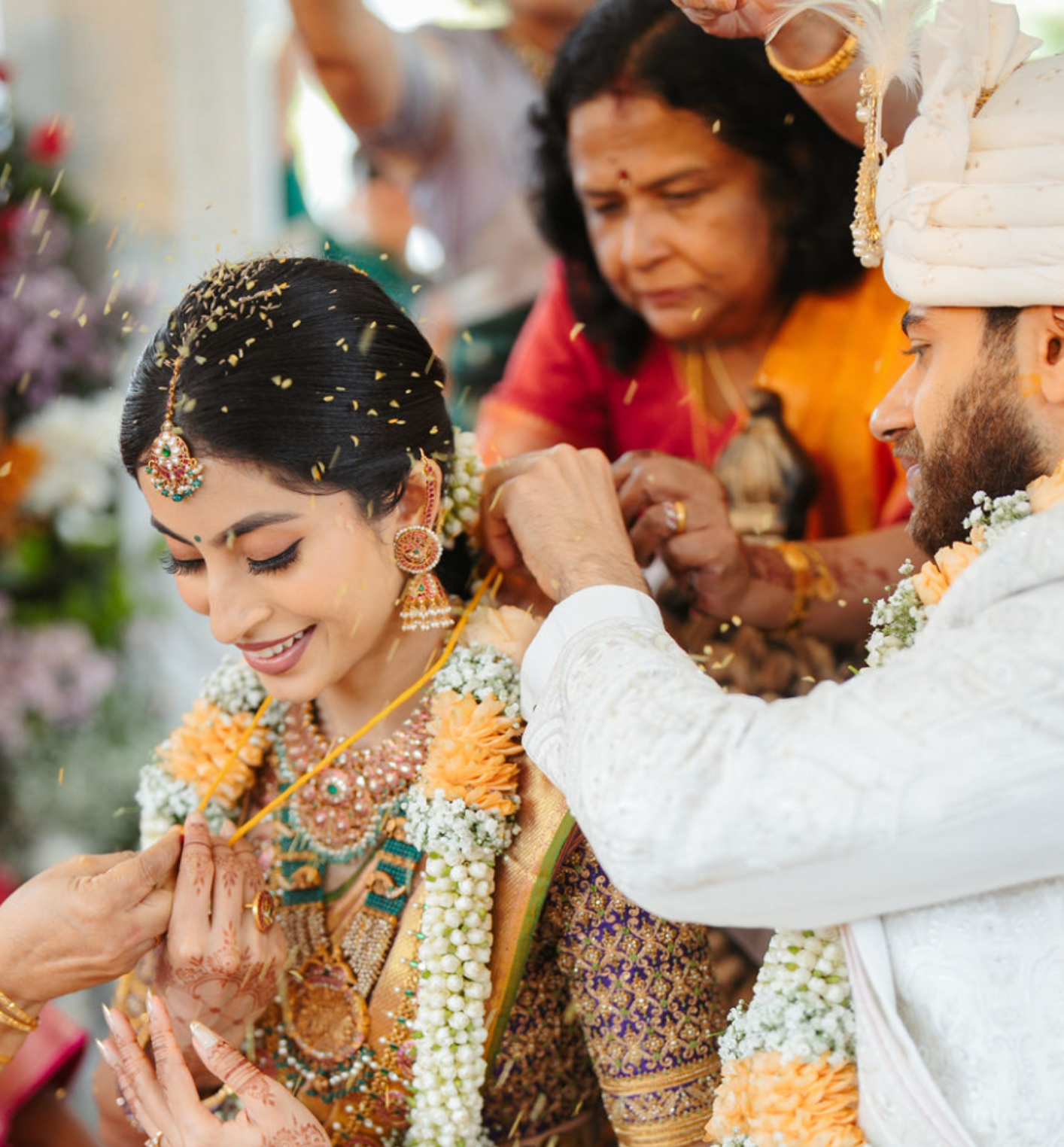
Considered a lifelong symbol of marital status, Mangalya Dharanam is the tying of the sacred thread around the bride's neck by the groom. This is the singular, defining moment of the wedding, timed precisely to the muhurtham. It is known as Thali in Tamil tradition or Mangalsutra more broadly.
Saptapadi (seven steps)
Saptapadi is the ritual of seven steps by the bride and groom together around the sacred fire, with each step representing a specific marital vow like nourishment, strength, prosperity, wisdom, progeny, health, and lifelong companionship. It is recognized under India's Hindu Marriage Act as a ritual that can validate a Hindu marriage.
Talambralu (rice shower)
Talambralu is a signature ritual in Telugu weddings, performed after the thali-tying and Saptapadi. The bride and groom, seated facing each other, shower each other playfully with rice. It symbolizes blessings for prosperity and abundance in the couple's shared life.
Oonjal ceremony
The Oonjal is the swing ceremony, most prominent in Tamil weddings, where the bride and groom are seated together on a decorated swing. Often, they're fed bananas and milk during this ritual. It represents the ups and downs of married life and the importance of maintaining balance and harmony together.
Post-wedding rituals & ceremonies
Once the core ceremony concludes, a smaller set of rituals follows. Some traditions are scheduled on the same day, while others are performed in the days after.
Grihapravesham (Homecoming)
Grihapravesham marks the bride's ceremonial entrance into her new marital home. This ritual symbolises the arrival of abundance and prosperity into the household. It's considered both a welcome ritual and an auspicious first act of the bride in her new home.
Reception rituals
Reception is a modern addition to South Indian weddings, distinct from the religious ceremony itself. Held either the same evening or on a separate day, it's a more celebratory event where the couple greets a much wider circle of guests who weren't part of the ritual ceremony.
Nalangu ceremony
Nalangu is a playful, competitive ritual traditionally performed either shortly after the main wedding. The bride and groom engage in a series of lighthearted games while family members cheer them on. It is meant to help the newly married couple bond and feel more comfortable with each other.
What the bride and groom wear for each ritual
South Indian wedding attire is an important part of the celebrations. Often both the bride and groom change outfits two to three times over the course of the ceremony or as required for different rituals. While the exact clothing varies between Tamil, Telugu, Kannada, and Malayalam traditions, traditional silk sarees, veshti/dhoti, temple jewellery, and gold accessories are common.
How long does a South Indian wedding take
A South Indian wedding is usually a 2-3 day celebration. Though elaborate pre-wedding and post-wedding customs may extend the events up to 3-4 days. While the main wedding ceremony itself lasts around 2-4 hours, it's the complete wedding-day experience that occupies most of the day.
For South Indian weddings, the exact duration also depends on the family's community, number of rituals performed, and the muhurtham selected by the priest.
Muhurtham
The muhurtham is the astrologically calculated auspicious time for the wedding, determined by a priest based on planetary alignments specific to the couple. South Indian muhurthams occur during early morning hours, sometimes right at dawn or pre-dawn. Since this dictates the entire wedding, couples need to ensure that the rituals leading up to it are scheduled on time.
Pre-Wedding Rituals
Duration: 1-2 days
It starts with ceremonies such as the small prayer, engagement, Vratham, Mehendi, Nalangu, and Sangeet. These are performed to seek blessings and bring both families together before the marriage.
Core Wedding Ceremony
Duration: 3-4 hours
The main ceremony takes place at the auspicious muhurtham. It includes the groom's welcome, Kashi Yatra, Maalai Maatral (garland exchange), Oonjal, Kanyadaanam, Thaali or Mangalya Dharanam, and Saptapadi. The exact rituals vary across different communities.
Post-Wedding Functions
Duration: 1 day
South Indian weddings focus more on tradition and a grand feast after the celebrations. It is followed by a formal evening reception, farewell rituals, Grihapravesham, and other family customs.
FAQs
What are the main rituals in a South Indian wedding?
South Indian wedding rituals vary mainly across Tamil, Telugu, Kannada, and Malayali communities. The main rituals in a South Indian wedding include:
. Kashi Yatra
. Oonjal (swing ceremony)
. Kanyadaanam
. Mangalya Dharanam/Thalikettu
. Saptapadi
How many days does a South Indian wedding last?
A traditional South Indian wedding generally lasts 2-3 days. It includes pre-wedding rituals, the wedding day, and the post-wedding & reception. Though couples often choose to complete their wedding in a single day, following only the core religious ceremonies.
What is Saptapadi and why is it important?
Saptapadi is a Hindu wedding ritual in which the bride and groom together take ‘seven steps’ or walk around the sacred fire. Each step represents a marital vow, such as nourishment, strength, prosperity, happiness, family, longevity, and friendship.
How is a Tamil wedding different from a Telugu wedding?
A Tamil wedding is different from a Telugu wedding in its unique customs, signature rituals, and the specific style of the mangalsutra (sacred necklace). Tamil wedding rituals include Kashi Yatra, Oonjal, and Ammi Midhithal, while Telugu weddings have special ceremonies like Jeelakarra Bellam and Talambralu.
What does the bride wear for a South Indian wedding?
A South Indian bride traditionally wears a beautiful silk saree, commonly a Kanjeevaram, in bright shades with heavy borders. It is paired with elaborate gold temple jewellery, including layered necklaces, earrings, bangles, armlets, and waist chains. The hair is often wrapped with jasmine flowers (gajra) along with traditional accessories.
You've made one decision. About forty to go.
Venue, date, budget, guest list — one expert takes all of it from here.
Peak demand venues